

Stinger - Chapter 2
The continuing story of a sailboat and a man's struggles with the past.
If a man must be obsessed by something, I suppose a boat is as good as anything, perhaps a bit better than most.
—E.B. White
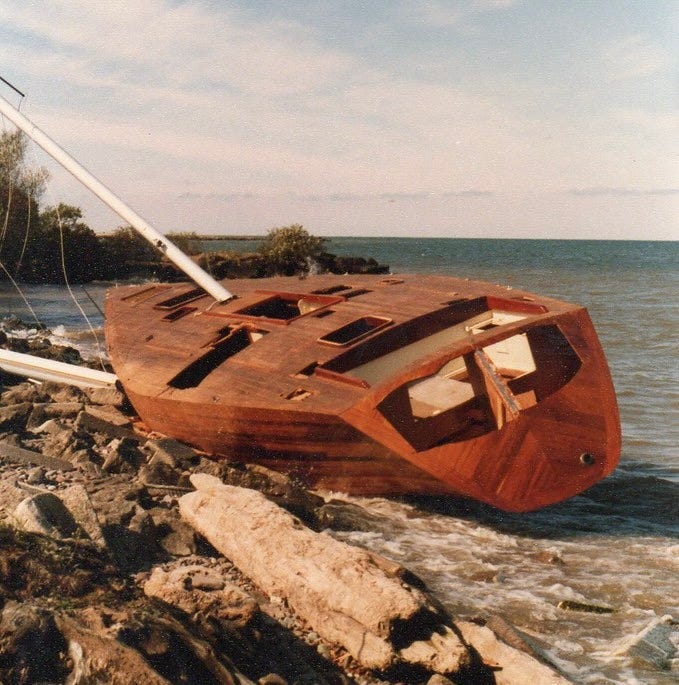
Photo credit: Jim Mitchell “Ship Wreck” Hamlin Beach 1981- flicker
Light was beginning to fill the room as a village snowplow clattered by, leaving a thick ridge of snow at the end of the driveway. The sound faded.
“Are you still excited? Because it’s hard to read you right now.”
“I am,” Gar said, suddenly realizing his coffee was growing cold.
Marin studied him for a moment. “I worry, Gar. We’ve been here before—when things seem to be going well, and you disappear.”
The radiator ticked. Outside, a shovel scraped somewhere down the street.
“You know I don’t mind the boat… I just need to know that you’re thinking about us and not trying to. . .” Marin shook her, not wanting to dig deeper.
Gar raised his head. “I know.” He nodded, looking back down at his coffee.
“I just don’t want you to go dark.”
Marin curled her fingers around her coffee and leaned back into the couch. Gar folded forward, his fist braced under his chin.
The snowplow passed a second time.
Gar set his coffee on the table.
“Everything’s going to be okay,” he finally said.
“Okay—look, I’ve got to get ready for work.” Her cup came down on the table harder than she intended. “You go take care of the boat business.”
“I’ve got to go to the lake again.”
“All the way back up there—why? You were there yesterday.”
“Dwight’s son is taking care of the stuff—sails,paperwork—it’s all up at Dwight’s.”
Marin stood and carried her cup to the window. “The roads look like crap.”
“I’ll be careful.”
“Take the Subaru.”
“Okay.” He hesitated. “Alrigh.”
Marin tapped her nails against the side of the cup.
“Gar, if you want our life to be good, you’ve got to make it good.” She turned to look at him with her patient smile that always looked forced. “Talk with your therapist—get it straightened out.”
She reached out and took his cup.
“Have you talked with him—about it?”
“Last month—I didn’t think I’d be interested in buying a boat.” Gar said, trying to avoid eye contact. “I’m going to see him this week.”
“Okay,” Marin cut him off. “I’ve got to get ready—you drive safe.” She bent over to hug his head. “Get it together, Langstrom—we need you here.”
On the way to the kitchen, she called back, “I’ll see you this afternoon.”
“I love you!” Gar turned back to the window and watched the streetlight go out.
Fifteen miles away, Jeff Brown looped a mask over his ears and stepped into the fluorescent wash of the pulmonary wing. The smell hit him immediately—cooked vegetables and antiseptic. After checking in, he moved down the beige corridor, sidestepping a meal cart and a nurse pushing an oxygen tank, until he reached his father’s door.
He pushed the heavy door slowly and was greeted by the steady beeping of the heart monitor and the soft hiss of oxygen. The room was bathed in a soft fluorescent light that cast stark shadows on the pale walls. His father, Dwight, lay motionless on the bed, his once robust frame now appeared small enveloped in crisp, white linens.
“Hey, Dad,” Jeff said, gently touching Dwight’s shoulder to wake him. “You wanted me to come in early to discuss Gar and Stinger. Remember?”
Dwight’s eyes fluttered open, and he began speaking in his familiar lilting voice, as if mid-thought. “Today,” he coughed, catching his breath, “Turn the light on. Turn the light on.”
Jeff took a moment to find the switch.
“Okay, okay,” Dwight tried to push himself up. “Okay, get that box down from the loft—the one that looks like a big munitions box. You know the one. Give that to Gar. And my ditty box… It’s full of history: pictures, early stuff, delivery documents, a few race flags. It’s not worth anything to anybody else.”
Jeff was comforted by his father’s familiar clipped, urgent cadence. His voice was from the era of black-and-white newsreels and baseball radio announcers, the words hammered out whether anyone was ready for them or not. A Depression era kid of fourteen in 1938, he had out-earned his father through sheer determination to work on the water.
“Yep, I got it—I know the ones you mean.” Jeff was fairly sure he would have to rummage around to find them.
“Good, good, good. Now also—you need to make sure—okay, make sure he knows the mast and boom are at Shelp’s. Tell him—tell him don’t let Clark Shelp try any tomfoolery and charge for storage. That storage is all paid up through summer along with the launch—got it?” Dwight paused, his hand trembling slightly as he raised it, signaling there was more to say. “The lines, sails, everything he needs are at the barn. You’re gonna meet him there today—right, right?”
“Yes, I’m all set to see him out there this morning. Can I get you anything? I’m going to head out so I can beat the snow.”
“No, no, nope. I’m runnin’ out of steam. Just one more thing before you go.” Dwight caught his breath. “Tell Gar I need to see him. Tell him it’s important and need to have him come to see me right away, posthaste, pronto. You can sign over all the stuff, but let him know. Tell him not today, though—I’ve had enough today. They gave me something this morning, but tomorrow—soon I need to see him.”
“I’ll take care of it, Dad. Want me to give you a call this afternoon and let you know? Think you will be up for a call?”
“Sure, sure, sure. Give me a call this afternoon. Alright. Get going, get going,” Dwight said with a weak grin that let Jeff know he was okay.
Jeff glanced at the monitor displaying Dwight’s oxygen levels and heart rate, noting the fluctuating numbers. He pulled down his mask and placed a kiss on his father’s cool forehead. “Okay, I’ll talk to you this afternoon, Dad,” he whispered before stepping out of the room, the door closing with a mechanical thud behind him.
Gar drove the Outback. Snow, which had been falling lightly at the start of his trip, grew heavier without warning. He quickly eased to forty-five, but even that felt reckless. Thirty-five felt no better. The car and the wind-blown snow matched speeds. The flakes seemed to hang in place, suspended beyond the windshield. The effect made Gar feel as if he were barely moving.
His jaw locked.
The interior of the car became his entire world. With fingers locked around the wheel, he eased the car to the right—listening, feeling for the tires to catch something, anything.
He continued slowly west.
And just as suddenly as he had driven into the whiteout, the road appeared again—but it gave no relief. The metallic taste in his mouth and the pounding in his chest forced him to choke out, “Jesus fucking Christ…” He pulled over as far as he could, searching with cramped fingers to find the four-ways.
Jeff Brown was driving eight minutes behind and never saw the snow squall that had enveloped Gar. He was a family man who, unlike his father Dwight, had no interest in tinkering with mechanics or the art of sailing. When he was younger, his father took him out sailing, but he never really understood what all the fuss was about. To him, it all felt pointless and slow.
Jeff continued west along the parkway as the snow became heavily rutted. He slowed down and eased into the left lane to give room to a car off on the shoulder.
Gar’s involuntary shaking had begun to subside, leaving only the occasional erratic rattle. Now would come the lingering adrenaline hangover along with the ghostly exhaustion that would follow him throughout the day.
He rested his forehead against the steering wheel for a moment and closed his eyes.
Slowly, he willed himself to release his grip on the steering wheel, allowing his forearms to come back to life.
A black pickup truck drove by just as Gar contemplated turning back for home.
Must be Jeff, he thought.
The parkway was quiet in the winter months, traveled mainly by the hardy souls who lived along the lakeshore and used it for their morning and afternoon commutes.
Gar considered the possibility of texting Jeff to let him know he wasn’t going to make it. But the thought was fleeting. Turning back wouldn’t ease the anxiety clawing at him, and the idea of Jeff having to drive out here just to turn around—Gar knew this outcome wasn’t an option.
Mairin always asked why he cared so much—what people thought. He never had an answer.
He took a slow breath and realized it was too hot in the car. Although his feet were freezing, he felt the sweat under his wool cap start to drip down his forehead. He yanked it off and tossed it onto the passenger seat, then rolled down the window. A large puff of soft snow filtered in, dusting him lightly. He looked back to check for traffic, then slowly pulled back onto the road, attempting to calm his breathing.
Jeff arrived at his father’s converted barn on Point Breeze Road—not on the creek side, but on the far side of the road. The wind had scoured away the snow, leaving the driveway and yard exposed.
He stepped out of his truck and was immediately aware of the absence of his father. Although he had spent countless hours alone here as a kid and even as an adult, the barn now seemed too remote—too lifeless.
This barn held almost all of Dwight’s worldly possessions. It was once part of a large farm belonging to generations of the Anderson family. But the Second World War took their only son, Avril, and the family’s future changed. With no heir, the farm shrank. As Avril’s sisters married, the property was gradually divided and parts sold off. By the early 1950s, the once-thriving homestead had become nothing more than scattered parcels of land.
The barn and surrounding five remaining acres went up for auction in 1952, and Dwight saw an opportunity to move his shop closer to the water.
The old gabled barn had originally housed workhorses. Its floor, laid even with the ground, was built from twelve-inch-wide boards nearly three inches thick—mostly chestnut and white oak, with the occasional piece of osage orange or catalpa—cut from the virgin forests that once covered the region so densely, early French explorers called it le nord noir—the Black North. Hoof marks from pawing Morgan horses still bore witness to the years before tractors.
Jeff found the key and entered through a side door. He quickly scanned Dwight’s shop. The shop radio was tuned to WHAM and was playing a local auto dealer’s jingle—Dwight never turned it off. He said it kept the raccoons away.
Jeff climbed the stairs to the second floor, where Dwight had converted the barn into a three-bedroom home. Trusses, left exposed, gave the large living area a cavernous, barn-like feel. Toward the back, over the kitchen and bedroom area, was an additional loft accessible via a set of old barn stairs that led up to a short door.
Jeff climbed the stairs and opened the loft door. He reached into the darkness to feel for the light’s pull string tied to an old wire staple. With a slight jerk, he broke the string off at the fixture’s pull chain.
“Fucking hell,” he murmured into the dark as he reached for his phone to light the way past boxes and scattered pieces of scavenged nautical hardware.
He worked his way through until he reached the bare bulb and turned it on. Looking around, he could see the worn top of the green box, stenciled with Ronald Jones, U.S. Merchant Marine.
Jeff lifted it with more effort than he expected. He knew he’d carried it up here, but that must have been over twenty-five years ago. Everything seemed to have gotten heavier over time.
He saw the smaller box close by and set it on top.
He ducked through the loft door and came down the stairs. He set the boxes on the coffee table with a thump and sat on the couch, letting the quiet of the place wash over him. The thought of parting with all his father’s things was too much. Jeff rubbed his eyes and sniffed hard, trying to hold it together.
Gar turned onto Point Breeze Road. A quarter mile ahead was a historic sign near the start of Dwight’s five acres. The markers were ubiquitous throughout the state, first commissioned by the Education Department in 1926. By 1936, more than two thousand had been scattered statewide.
This one read:
Tiyanagarunte Creek, Seneca for “Where She Threw the Stick at Me.” Site of the last Seneca Indian villages to survive the Sullivan Campaign of 1779.
Gar registered the sign subconsciously as he slowed the car. Ahead, he saw Jeff’s black truck already in the driveway. He pulled in behind it and stiffly got out, trying not to appear enfeebled.
Walking up to the door, he knocked, taking one last deep breath. He heard footsteps coming down the stairs, and then Jeff appeared.
“Hey, come on in. How are you?” Jeff asked, reaching to shake Gar’s hand.
“Oh man—I hit some snow on the way up,” Gar said with a grimace.
“Thought that might’ve been your car on the side of the road. Was that you?”
“Yeah… well, my son called and wanted to ask about the boat,” Gar lied.
“Is he excited?”
“Yeah—he wants to come up this summer and sail. He’s down in Virginia now—maybe he’ll help me get her ready.” Gar figured that was mostly true, then tried to change the topic. “I’ve only got my wife’s car,” he said, glancing toward the driveway. “I might not be able to take all the stuff today.”
“No hurry—you can grab some of it today or leave it. It’ll be in the area for a while,” Jeff said. “I’ll walk you through the shop, make sure we can find all the stuff.”
Gar followed as Jeff flipped on the wall switches, bringing most of the cold fluorescent lights blinking to life. They hummed softly, illuminating the machinery Dwight had collected over the years. Gar guessed all of it was made before 1970.
The electric planer, shaper, router, drill press, jointer—even the woodworking bench—all sat heavily grounded on the old barn floor. Built in a time before lightweight meant better.
“Dad’s got everything he needs to build a boat if he wanted to.”
Jeff nodded slowly, looking around.
Gar’s thoughts raced—I needed a bigger car. What the hell am I doing buying a boat?
He realized Jeff was waiting on him.
“This is amazing,” Gar said. “I haven’t been down here in years.”
“He always liked wood better—the Triton was kind of an anomaly. He just loved the lines, I think. It gave him more time to sail and work on other projects.” Jeff gestured toward a couple of engines along the wall. “The one on the right is the original Atomic Four out of the Triton. Dad said you could have it if you think you want it.”
Jeff shrugged.
“It ran well when we pulled it—folks still love ’em,” he added, sensing Gar’s hesitation. “There’s a pretty big owners’ group I found online. I’m not sure why you’d ever really need it.”
Gar nodded.
“You know, I’ll probably be fine with that Yanmar. I appreciate the offer.”
Gar looked down at the old gold-painted engine with reverence. His instinct was to keep it, but this was a three-hundred-pound problem he figured he could live without.
“So why’d your dad end up switching to the Yanmar instead of just living with the A-Four?” Gar couldn’t help his curiosity.
“Well, there’s a bit of a story behind that,” Jeff said with a hint of a smile. “I used to worry about this getting out, but I figure enough time has passed.”
He rubbed his chin, looking down at the Atomic Four.
“You might remember—back around 1980—there was a thirty-four-foot cold-molded sailboat coming across on its maiden voyage out of Toronto.”
He raised his eyebrows, watching Gar for a reaction.
“Yeah, weird—I remember. They were heading south to race, as I recall, but ended up on the rocks at Hamlin Beach—right?”
“Yep. Remember the name?”
“I don’t think I ever heard it,” Gar said, an inkling forming about where the conversation was going. “I drove down to see it with Sid Murphy—you remember him—right?”
“Oh yeah, I know Murph,” Jeff said, rolling his eyes slightly before nodding for Gar to follow him.
He slid back a door and flipped on the lights, illuminating an even colder room, one that looked only slightly newer than the barn.
Hanging on the wall was a three-foot-long, thickly varnished board with gold script:
“Bye, Bye, Blackbird — RCYC.”
On closer inspection, Gar could see that it had been cut out with a chainsaw.
“You guys got there first? By the time Murph and I got there, the thing had been hacked to pieces,” Gar said, stepping in closer for inspection. “You guys took every bit of deck hardware off that boat—that was you…?” Gar shook his head in surprise. “The crew fell asleep—that’s the story I heard. I never really understood that part.”
Jeff looked at him.
“Okay, here’s what really happened—remember, it was October? They were forecasting a gale. That thing came roaring across the lake way sooner than anyone expected. Dad heard them on the radio calling for help from the Canadian Coast Guard after they blew the mainsail out. The Canadians told them to call the Rochester guys because they were way closer.”
“So the crew hadn’t been asleep?” Gar asked, riveted by the unfolding details.
“Nope. There were a lot of rumors, but here’s what happened. The main was gone, they were in two hundred feet of water, trying to crawl offshore when a wave skidded them backward and swamped the engine—water came through the hatch. And in those conditions, the anchor was useless. The keel hit and broke off, and the waves drove them far enough ashore that the crew jumped off into chest-deep water—they all made it.”
Jeff leaned against a workbench.
“I joined the Coast Guard soon after that and was able to look at the Rochester logbooks. So I can confirm that’s what happened.”
“So you and your dad went out that night and salvaged it all?”
“No, the weather was crazy that night and all the next day. You couldn’t get near it.”
“So, was it the next night?”
“Yep—me, Dad, and Eddie Farmer. We waited till midnight, grabbed some flashlights, and brought a couple of chainsaws and cable cutters. We needed Eddie’s truck. I ended up out on the road keeping an eye out. Dad could hardly see in the daytime—I heard Eddie yelling at him not to start up a saw, but you know my dad…”
“I remember Eddie… he was kind of a different sort of guy,” Gar said.
“Well, here’s the deal with Eddie—he had Tourette’s and he drank. He claimed the alcohol helped—but I don’t know. Dad liked him. Anyway, they cut the transom out trying to get to the motor and hit a big support piece for the backstay in the way. That’s why they had to take the engine out the side.”
Jeff slowly lowered his outstretched hands as if letting go of something heavy.
“So we got it out and hauled it to the truck. They went back and cut all the deck hardware out. I grabbed that piece of the transom, and it’s been hanging on that wall ever since.”
“Holy shit… so that’s the Yanmar?”
“Yep. That’s the story.”
Jeff walked over to switch off the light, and Gar followed him.
Jeff pointed at the sail bags hanging from the joists above their heads.
“Think that’ll all fit in your car?”
“Yeah.”
Gar reached into his pocket and pulled out a bank envelope.
“Let me pay you first—we’re good with six thousand?”
“Dad said that’s the friends-and-family price,” Jeff said with a smile as he took the envelope and put it in his pocket.
Gar glanced toward the car.
“Maybe I’ll put the cushions in first and see how much room is left.”
The two men quietly began moving the stored items out to the car. The last items were the extra sails.
“You got the newer genoa and the light one-fifty. There’s that storm jib along with the extra main in the same bag.” Jeff looked around. “Some of these haven’t seen the light of day in a long time. That one spinnaker is probably original—it’s got big shoulders. The other is a reacher, I think.”
“The car’s pretty much packed full,” Gar said, absently glancing around as if ready to leave.
“Jeez, I almost forgot—Dad’s got a couple boxes upstairs he wanted me to make sure you take. Some stuff that goes with Stinger. Follow me up and I’ll get it for you.”
Gar followed Jeff upstairs. He entered the home and looked around, remembering the loftiness of the room—he hadn’t been here in years.
“It’s kinda heavy,” Jeff said, leading Gar to the table. “Dad wanted you to take this. He made sure I told you that he wants to talk to you, too.”
“I’ll call over to the hospital when I get home,” Gar said, lifting the weighty box with a twinge of apprehension.
“Well, he really wanted you to come see him—that’s what he said: ‘Make sure and tell Gar to come see me right away.’”
“Yes—sure, I’ll go see him. I didn’t know… I mean, I didn’t know if he was up for visitors…” Gar’s mind began imagining how a visit might play out.
“Yeah, he seems in good spirits—though this morning he was wiped out from the meds they give him. I’d just call first to see if he’s up for a visit. Afternoons seem to be his best time.”
“I’ll do that.”
Gar looked at the sea chest.
“Ronald Jones… somebody he knew from the war?”
Jeff laughed.
“Ask him about that when you see him. It’s a good story. I’ll walk you out—I’m heading back to Buffalo in a bit.”
They stepped out into the cold. Jeff helped rearrange a few sail bags in the back of Gar’s car to fit the sea chest. As they shook hands, Jeff gave him a knowing look.
“It’ll be good to get back out on the water. It’s been a long time, huh?”
Gar nodded, glancing at the box in the back seat.
“Too long.”
Jeff slapped the roof of the car and hesitated.
“One of the guys at the Rochester station was on duty that night of your accident. He told me about it.”
Gar felt panic at what Jeff knew—or thought he knew.
“I can only imagine what it takes to get back out on the lake,” Jeff said in a kind voice that calmed Gar’s thoughts slightly. “Well, see you around, Gar. Let me know if you’re missing anything.”
“I appreciate that,” Gar said, hoping Jeff wouldn’t see that the blood had drained from his face.
Then he hesitated before shutting the door.
“Yeah… I’ll let you know.”
His voice felt distant, even to himself.
He turned to back up, but his eyes lingered on the box for a moment.
He pulled onto the road, the weight of it—of everything—still with him.
Yessir. Bang, just like that, Chapter 2 is n the books. Keep the momentum going Kyle, you’re going to hit your stride on this baby. I could feel it building myself, along with the story, as I was reading. Writing, like so many other things is a mental game, and I can tell right now that you have the wind at your back. - Jim